


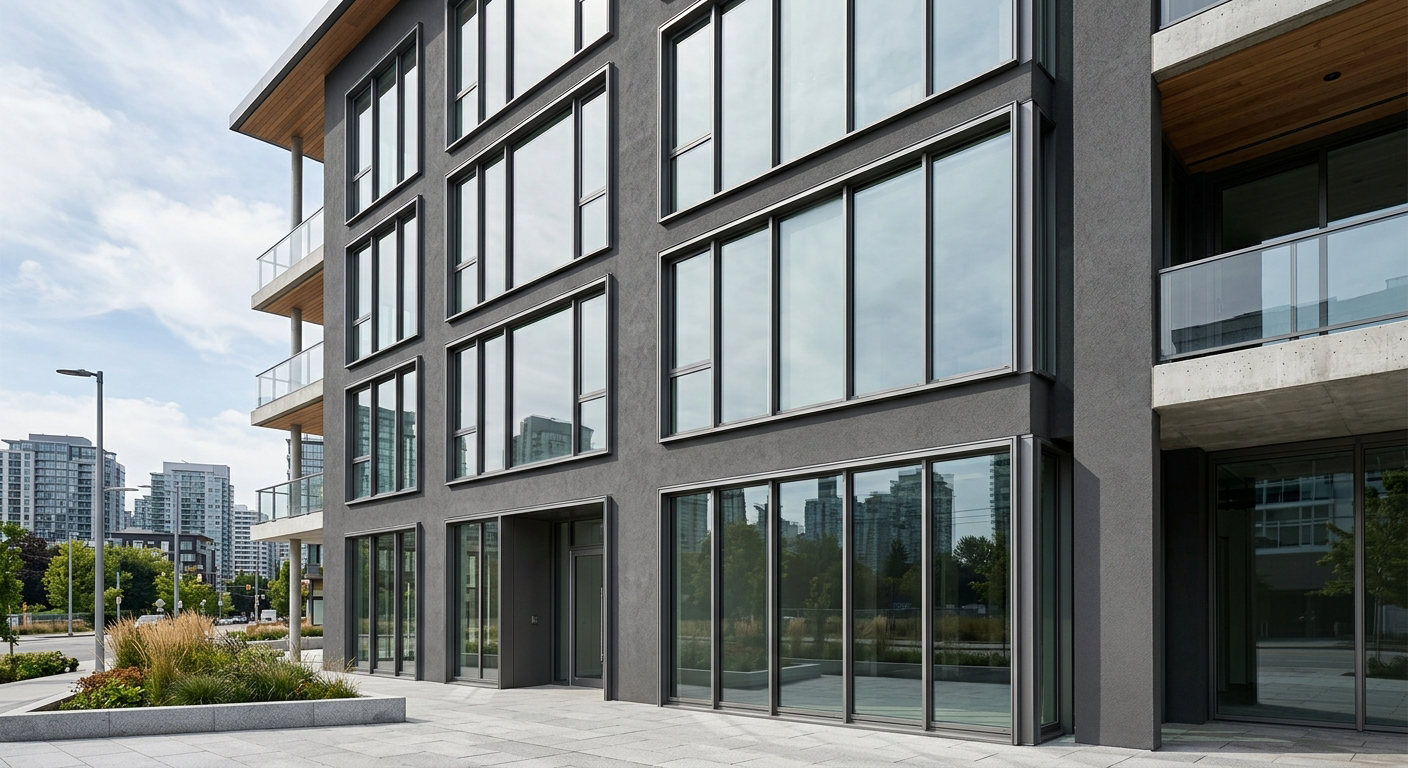
When people think about windows, they focus on the glass. That makes sense. But the trim around the window does more work than most people realize, and when it is made from aluminum, it does that work for a very long time.
Aluminum window trim is the framing material that surrounds and finishes a window opening. It sits at the border between the window unit and the wall, sealing the gap, protecting the structure from water and air, and giving the installation a clean, finished look.
It is used in residential and commercial buildings alike. You will find it on new construction, on renovation projects, and increasingly on high-end facades where the aesthetic finish matters as much as the performance.
Not all trim is the same. Wood rots. Vinyl expands and contracts more than most people expect. PVC can yellow and become brittle over time.
Aluminum holds its shape. It does not absorb moisture, does not swell in the rain or crack in the cold, and does not need to be repainted every few years to stay presentable. In coastal or high-humidity climates, like much of the northeastern United States, that stability matters.
There is also the question of profile. Aluminum can be extruded into precise, slim profiles that give a window a sharper, more architectural look. This is one reason it is the default choice for commercial storefronts and for residential projects where the design intent is clean and modern.
The main variables are profile, finish, and coating.
Profile refers to the shape and depth of the trim. Flat trims sit flush against the wall and create a minimal, contemporary look. Deeper or stepped profiles add shadow lines and visual weight, useful when the facade needs more definition.
Finish can be mill (raw aluminum), anodized, or powder coated. Anodized finishes penetrate the surface of the metal and offer good resistance to corrosion without adding much thickness. Powder coating gives a wider range of color options and a slightly softer appearance.
Color is worth thinking about early. Aluminum trim can be matched closely to the window frame color, or used as a deliberate contrast element. Getting this decision right in the planning phase avoids problems later.
In commercial construction, aluminum trim is standard, on storefronts, curtain walls, and office buildings where longevity and low maintenance are non-negotiable.
In residential projects, it tends to appear in higher-end builds: single-family homes with strong architectural intent, multi-unit buildings in urban settings, and renovation projects where the goal is to modernize the facade without replacing the entire window system.
In New York specifically, where building regulations are strict and facade maintenance can be complicated in dense urban environments, aluminum trim is a common and practical choice.
A few questions worth asking before specifying:
The trim needs to work with the substrate behind it. Masonry, metal stud, and wood frame all have different requirements for anchoring and sealing.
North-facing walls in colder climates have different demands than south-facing walls in humid coastal areas. Coating choice should reflect the actual exposure.
Trim that clashes with the window frame or the cladding material tends to be visible for all the wrong reasons. Consistency matters.
Aluminum trim can cover small imperfections in the rough opening, but it is not a substitute for a well-prepared installation. The cleaner the opening, the better the trim will look.
Aluminum trim is straightforward to install, but a few things are worth doing carefully.
Sealant joints need to be continuous and properly tooled. Gaps at the corners or along the edges are where water finds a way in. Using a backer rod before applying sealant helps control joint depth and gives a cleaner finish.
Fasteners should be stainless steel or coated to avoid galvanic corrosion where aluminum meets steel. This is a detail that gets skipped more often than it should, and the consequence shows up years later as rust staining on the facade.
If the trim is being installed on a building with an exterior insulation system, the anchoring detail needs to account for thermal movement. Aluminum expands and contracts with temperature changes, and a trim that is fixed too rigidly will eventually show stress cracks at the joints.
Trim is only part of the picture. The window system behind it determines how the whole assembly performs over time.
At Ecosupply, we supply and install aluminum windows for residential and commercial projects across New York. If you are working on a new build or a renovation and want to talk through the options, we are happy to help.
